Sponsors

Wasser Glass

A&A Products

Aanraku Glass Studios

American Glass Supply

Anything in Stained Glass

Armstrong Glass Company

Artisan Dichroic

Blue Fire Molds

Bullseye Glass

COE90.com

Contemporary Fused Glass.

Curious Glass Shop

Delphi Glass

Dichro Depot

Dichroic and More

Ed Hoy's International

Evenheat Kilns

Hang Your Glass

His Glassworks

Hollander Fusing Center

Hot Glass Houston

Kiln Frog

Lincoln Distributors

Nartique Glass

Olympic Kilns

Paragon Kilns

Skutt Kilns

Slumpy's

System 96

TMS Studios

The Joy of Coldworking

Uroboros Glass

Warm Glass UK

Ceramaguard

Click here to order Ceramaguard through the Warm Glass site.

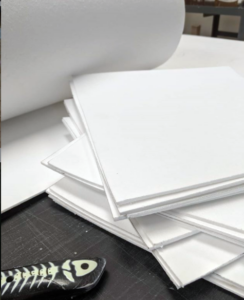
Ceramaguard is a commercial ceiling tile that is manufactured by Armstrong.  It is made to be used in commercial suspended ceilings where fire resistance is a priority.  Its color is white and it is finished on one side with a factory-applied vinyl plastic paint.  The product is manufactured in sheets that are 2 feet by 4 feet (600 by 1200mm).  It is around 5/8" thick (around 16mm).  The surface of most Ceramaguard is covered with small fissures, although unperforated Ceramaguard is sometimes available.   The unperforated variety is not perfectly smooth, but it is fairly free of deep fissures or cracks.  Either type, perforated or unperforated, will work well for fusing and slumping applications.

From a warm glass perspective, the principle use of Ceramaguard is to make drop rings and similar molds.  Ceramaguard  is easier to cut than fiber board; you can use a hacksaw, a regular saw, or even a craft knife or similar tool.  It can also be easily worked with tools such as a table saw or a power drill.  Cutting it may produce a lot of dust, so it's a good idea to wear a mask.  Once cut, Ceramaguard will not continue to deteriorate the way the fiber board can, although the edges can get a bit banged up from handling.


Although it warps less than fiber board, Ceramaguard should still be well supported with kiln posts during firings.  It is strong enough to stand on end if desired.  No separator is required for temperatures below 1300 to 1350 F (roughly 700 C), but because the texture of Ceramaguard is sometimes uneven fiber paper or kiln wash is often used to impart a particular texture to the underside of the glass.  It has a low thermal mass and heats (and cools quickly).

Ceramaguard can also be used at fusing temperatures, but a kiln wash or fiber paper is highly recommended.  Best results are achieved with pieces that are one square foot or less and are well supported in the kiln.  Larger pieces of the board tend to warp at fusing temperatures, but smaller pieces may be suitable for use as a kiln shelf, especially if well supported with kiln posts.


Ceramaguard is fragile and must be treated with care, but with proper treatment it will last quite a while.  It needs to be pre-fired to 1250 F (it will smell like burning sugar and may give off some smoke, so make sure your kiln is vented slightly) The paint may flake off during firing (especially the first firing).  You may fire on either the painted or unpainted sides of Ceramaguard, and may cut or carve the Ceramaguard either before or after pre-firing..  

From a health perspective, Ceramaguard is safer than most ceramic fiber boards, but it is not perfectly harmless.  It is made of fiberglass wool, which irritates some people, especially those with lung conditions or sensitive skin.  It should be handled with care.  You can access the full Material Safety Data Sheet on Armstrong's site by clicking here.  

Click here to order Ceramaguard through the Warm Glass site.

A very special thanks to Graham Stone, author of Firing Schedules for Glass: A Kiln Companion, from whose emails and bulletin board posts much of the above is adapted.  Thanks also to Graham for bringing Ceramaguard to my attention.  -- Brad Walker, Warm Glass