|
GLASS ENAMELS
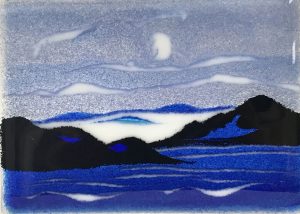
Although traditional painting on stained glass is probably the most common
way of painting on glass, painting with glass enamels has grown significantly in
popularity the last few years. The range of colors is extensive, and the ability
to mix colors means that a virtually unlimited palette is available.
These "paints," which like traditional
stained glass paints are actually finely ground glass particles with a
relatively low melting point, are available in both transparent and opaque
colors. They are applied, then fired onto the glass using a kiln.
Because glass enamels are made of tiny glass particles, care must be taken to
ensure that they are compatible with the base glass being painted on. As with
any other glass, using incompatible enamel will result in cracking or poor
adhesion.
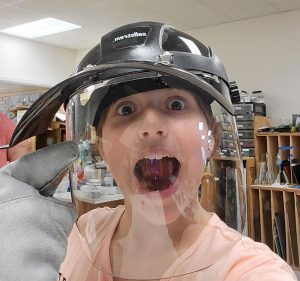
Care must also be taken when using glass enamels that the fine particles are
not inhaled. A respirator or mask is recommended to prevent this, as inhaling
fine glass particles can cause silicosis, a serious and potentially fatal lung
condition.
There are a number of ways in which glass enamels may be applied, but in most
cases the enamels are applied and fired in several layers. This maintains the
integrity of the colors and also helps to achieve effects that would not be
possible in a single firing. It is not uncommon for enamels to require four or
five or more firings before the work is complete.
The most common ways to apply glass enamels are by brush,
by dry sifting the enamels onto the glass, and by screen-printing.
Back to top
BRUSH APPLICATION
To apply enamels with a brush, you must first mix the glass particles with a
liquid (called a "medium") to obtain a paint-like consistency. Mediums
may be oil or water-based, but water-based mediums have the advantage of
generally being safer and easier to clean up. The key criterion is that the
medium fires clear without leaving a residue. Commercial preparations are
available, but good results have been reported from using substances as common
as 7-UP (or Sprite, if you prefer).
The proper consistency for painting is approximately one part enamel to two
parts medium, but this can vary depending on the particular enamels used. It's
a good idea to mix the paints on a smooth surface (a sheet of window glass is
ideal), adding the water drop by drop until the desired consistency is reached.
Sometimes the paint will dry out a bit during painting and you will need to add
a few extra drops of water.
Any brush may be used, but recognize that transparent enamels tend to show
brush marks. Take advantage of this by using the brush to create desirable
patterns and textures. (Opaque enamels are less likely to exhibit this trait.)
Once application is complete, the enamels should be allowed to dry prior to
being kiln-fired. Enamels will mature at various temperatures, with opaques
generally requiring higher temperatures (around 1450 degrees Fahrenheit) and
transparents needing only to be fired to around 1200 degrees F. For enamels that
fire at this lower temperature, it is possible to both slump and fire on enamels
in the same firing. Many of these lower-firing enamels contain lead, so care
should be taken not to use them on food-bearing surfaces.
It's possible to achieve significantly different results by varying the
method of brush application. The enamels can be mixed very thin and splattered
onto the glass a la Jackson Pollock. They can be applied, allowed to dry, then
scratched partially off to yield interesting patterns. Often, the best results
come from very thin applications and multiple firings; thicker applications tend
to result in a dark, muddy appearance.
Also, many glass artists use "reverse painting" techniques. This
approach, which is contrary to "normal" painting techniques which
start with the background and add details as a final step, starts on the
backside of the sheet of glass. Working from the top layers to the bottom,
successive layers of paint are added and fired until the picture is complete.
Although the approach appears strange at first, it results in a work with an
exceptionally clear and glossy surface.
Remember that when firing enamels you must follow the normal warm glass
procedures to heat, anneal, and cool the glass to prevent cracking and thermal
shock. Fired properly, the enamels will bond to the glass, resulting in a
permanent, lustrous finish.
Back to top
DRY APPLICATION
Glass enamels can also be applied dry. To do this, simply place a small
amount of enamel powder in a sifter and sift. You can add interest by drawing
patterns in the sifted powder or masking off a portion of the glass
"canvas" to control where the powder goes.
If you work with glass enamels, it's a good idea to wear a mask to keep
from inhaling the glass particles. This is especially good advice if you are
sifting and working with dry enamels, which can easily become airborne.
Click here to go
the next use of glass enamels to paint on glass, Screen Printing.
|