|
PATE DE VERRE
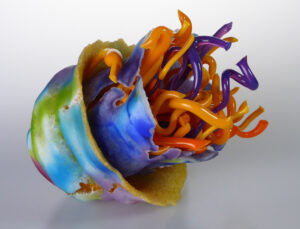
Pate de verre involves making a paste of glass that is applied to the surface
of the mold, then fired. The big advantage to pate de verre is that it allows for precise placement of particular glass colors in the mold. Other
ways of filling the mold often result in some shifting of glass from where it
has been placed prior to firing, but the pate de verre process helps to control
this shifting.
Pate de verre dates back to the ancient Egyptians, but it really came into
its own about a century ago when it was revived by a group of French artists who
gave this warm glass technique its current name.
In traditional French pate de verre, the artist mixed crushed glass with
enamels or paint to form a paste that was carefully placed in a mold and then
fired. Many of the pieces that were made using this technique were relatively
small, elaborately decorated, and required more than one firing before they were
complete.
The modern equivalent builds on this traditional foundation. Generally the
pate de verre process involves creating a paste from frit (small particles of
glass). Frit of any size may be used, but most good glass pastes require smaller
sizes (even powders) to be used. For this reason (and because the smaller the
pieces of frit the more opaque the casting), pate de verre castings tend to be
translucent (or even opaque).
Once the mold is thoroughly dry and the frit has been secured, the next step
is to make the glass paste. In some cases, where the mold has gently sloping
sides, the glass can simply be mixed with distilled water to form the paste.
Most molds, however, will require that glue be mixed with the glass to form the
paste. Special glues can be purchased, but white glue or gelatin diluted with
distilled water will generally work well. It’s a good idea to wear a mask or
respirator while mixing the paste to prevent inhaling small glass particles.
Use a brush or thin palette knife to apply the glass paste to the sides of
the mold. Start with a relatively thin coating (about 1/16"). Some artists
fire this initial coating to tack fuse (about 1400 F), others let it air dry or
use a hair dryer to speed up the process. After the first layer dries, a second
layer of paste should be added to bring the total thickness to around 1/8"
(3 mm). Gently pack the layer down as much as possible.
If your mold is hollow or slopes significantly, you will need to pack the
inner surface of the mold to prevent glass movement during firing. Sometimes a
second mold is created to fit inside the first mold. Alternatively, you may pack
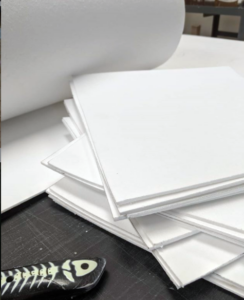
the mold with fiber paper to prevent the glass from slipping out of
place.
Click here to
go to the next part of the Kiln Casting section, "Firing the Casting."
|