PATTERN BARS
A pattern bar is a thick bundle of glass that has been fused together to form
a solid mass. The size of pattern bars can vary, but most are one or two inches
b
y about an inch and several inches long. When formed, these bars can be cut
into slices with a glass saw, lapidary saw, or trim saw and then re-fused to
make unique items.
Pattern bars are related to murrine, mosaic cane developed to its height in
Italy and often formed using lampworking techniques. Millefiori ("thousand
flowers") are the best known of these canes, which can be sliced and used
in fusing projects. If you wish to make similar items using a kiln, the pattern
bar methods described in this section will help you get the job done.
• Cold bundling
This technique, in which strips of glass or stringer are bundled together to
form one large pattern bar, works well for simple forms. The glass bundle should
be wrapped in fiber paper, then tied together with a high temperature wire (such
as nichrome wire) and stood on end in the kiln. Fire to full fuse, then anneal
and cool. Because of the thickness of the fused glass, care should be taken not
to anneal or cool too quickly.
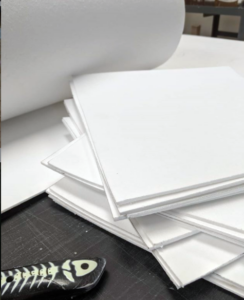
Stacks of glass strips may also be fused to form pattern bar strips. To
maximize the evenness of the strips and minimize the likelihood of distortion d
uring firing, the
stacks should be supported by fiber paper, fiber board, and
kiln furniture, as illustrated in the photo to the right. This layout allows you to
form a large number of patterns bars at one time.
• Using a stainless steel
A alternative to bundling, this method of making pattern bars involves the
use of a stainless steel mold to hold the glass strips. For best results line
the mold with fiber paper, then arrange the strips inside, fire, anneal, and
cool.
This approach has several advantages over simple bundling. First, unless
carefully prepared the bundled strips have a tendency to deform or even topple
over in the kiln. Second, using a mold allows you to use frit and other
irregular shapes that can't easily be used when bundling. Finally, the small
shape allows it to use space that would otherwise be wasted in a casting or full
fuse firing.
• Using a plaster/silica mold
This technique, which is really a simplified version of kiln casting,
involves using a plaster/silica mixture to form a mold for containing the glass
to be fused together. Wax is the best substance to be used to form the mold, but
other items can be used, including small wood strips.
The section on Kiln Casting (see advanced topics) discusses how to create the model and manufacture
the mold. The spaces created by this technique can be filled with strips of glass
or frit, then fired to full fuse and annealed and cooled.
When cool, carefully break through the plaster/silica mold. Slice the pattern
bars into cross-sections and re-fuse to form a new object.
One advantage of this technique is that round items can easily be made by
selecting a round shape to form the hole. Round slices are particularly
fascinating to fuse together because they deform and form hexagrams when fused
together side by side.
• Using Styrofoam
This final technique builds on the plaster/silica method by using Styrofoam
to form more complicated shapes. Start with a block of Styrofoam the size and
shape of the pattern bar you desire. Then cut the Styrofoam lengthwise using a
hot wire Styrofoam cutter.
Take the two (or more) pieces cut from the Styrofoam and use them as the
models to be encased in the plaster/silica mixture. Although they fit together,
mold them separately. If you burn out the Styrofoam, you'll be left with a
form the shape of the Styrofoam model.
There are several ways to get rid of the Styrofoam. One method is to pour
acetone onto the Styrofoam. This will dissolve it, but care must be taken
when handling acetone. Another procedure is to use a
small propane torch to burn out the Styrofoam. You can also use a well-vented kiln (fire to about 1200 F).
In either case, avoid inhaling the fumes and make certain you have adequate
ventilation.
Once your Styrofoam has been removed, you're ready to fill the remaining
form with glass. You can use strips or frit (as in the other types of pattern
bars), or you can simply fill each form with a different color of glass.
When you're ready, fire to 1500 to 1550 F, soak until the glass settles
(you may want to top up the form), then anneal and cool.
Once the forms are cool, carefully break away the plaster/silica mixture.
Slice the bars with your glass saw and fit the shapes together. Re-fuse this
assemblage to form a uniquely patterned warm glass object.
Click here to go to the
main Advanced Techniques page.