|
Preparing the Kiln for Firing
If you've never used your kiln before, then you'll
need to prepare it for the first firing. Both the kiln floor and the top surface
of the kiln shelf will need to be protected so that your glass project doesn't
stick to them.
Let's start with the floor of the kiln. The first thing you'll need to do
is to vacuum (or "hoover") the floor. Using a vacuum cleaner is the
best way to remove any dust or other unwanted particles from the bottom of the
kiln. When vacuuming, take care not to hit the kiln elements or dig the nozzle
of the vacuum into the soft fire brick that usually makes up the walls and floor
of the kiln.
Once the kiln is vacuumed, you'll need to protect the floor. This is so
that stray pieces of glass that fall off the kiln shelf will not eat into the
kiln floor. The best thing to use to protect the floor is kiln wash, a solution
that when applied properly will prevent glass from sticking to the kiln
floor.
MIXING KILN WASH
There's nothing magic about using kiln wash. Compared to cutting glass, it
doesn't even require much practice. You do, however, need three major
ingredients.
• Kiln wash. This usually comes in a powder that needs to be mixed
with water. You can buy it or make it on your own if you prefer.
• A jar to hold the kiln wash. Glass is best. A tight fitting lid is
essential.
• A brush or sprayer to apply the kiln wash. Applying with a brush
requires less preparation, but spray application is generally a bit quicker
and leaves a smoother, more even, finished surface.
In addition to these ingredients, it's a good idea to be cautious when
mixing and using kiln wash. The dry powder can be hazardous when inhaled. If you
are using a sprayer to apply the kiln wash you should be especially careful and
might consider wearing a respirator to avoid inhaling airborne particles.
Mixing kiln wash is simple. Just put the desired amount of the powder into a
glass jar, then add the amount of water recommended by the manufacturer. Usually
you add four to six parts water for each part kiln wash. Shake the jar to mix
the powder and water together. The final mixture should be relatively thin. If
you dip your finger in, it will leave a chalky residue.
APPLYING KILN WASH WITH A BRUSH
Most people use a Japanese "haike" brush to apply kiln wash. This
kind of brush has very fine bristles that allow the kiln wash to go on more
smoothly. You can use a regular paintbrush if you want, but make sure the brush
has wide, soft bristles. Foam paintbrushes also work well for kiln washing cool
surfaces, but don't use them with hot shelves or molds.
To apply the kiln wash, it's often best to pour a bit of it into a bowl to
allow easier brush access. (Some artists use a jar that has a mouth that is wide
enough to accommodate the brush.) Make sure you shake the kiln wash mixture
before pouring, as it settles very quickly. You should also stir the mixture
several times while applying to keep all of the particles from settling to the
bottom.
To brush on the kiln wash, first dip the brush into the mixture until it is
fully saturated. Glide it over the item you want to coat, usually a kiln shelf
or the floor of the kiln. Glide in one direction, allowing only the tip of the
brush to touch the surface. Don't drag the brush or draw it back and forth as
though you were painting. Apply a thin coat, rather than a thick one.
You should apply at least four coats, each in a different compass direction
(right to left, top to bottom, then once more in each of the two diagonal
directions). Then allow the kiln wash to dry. If you want this to happen more
quickly (air drying can take as long as a day), you can speed up the drying
process by heating the kiln to about 500 degrees F (take about half an hour to
do this) and then letting it cool naturally. When you fire, leave the kiln door
propped open slightly to allow the moisture to escape.
Once the kiln wash is dry, inspect the item to make sure it is covered with a
smooth layer. If you want, you can smooth the kiln wash slightly with a soft
lint-free cloth - an old pair of pantyhose works well for this purpose. If the
item is a mold that will be slumped into, check to make sure that the air holes
at the bottom have not been filled by the kiln wash. If they have, just re-poke
them using a bent paper clip or similar thin wire.
If you want your shelf to be as smooth as possible, try rinsing your brush in
clean, warm water and applying two or three additional coats of warm water to
the surface of the shelf. When the water dries, it will leave an exceptionally
fine and smooth surface.
APPLYING KILN WASH WITH A SPRAYER
The procedure for using a sprayer to apply kiln wash can vary slightly
depending on the type of sprayer used. For airbrushes and similar equipment,
follow the manufacturer's recommendations in terms of sprayer preparation and
use.
When using a sprayer, the kiln wash should be mixed just as for using a brush
-- about four to six parts of water for each part kiln wash. Take care not to
mix the wash too thick or it may clog the sprayer.
Spray the wash evenly from side to side, covering the entire surface with a
thin, smooth layer of kiln wash. It may be necessary to go over the surface
several times to ensure sufficient coverage.
Because of the risk of in advertently spraying kiln wash on kiln elements, it's
a good idea to use a brush for applying kiln wash to the floor of a kiln. Also,
a respirator or mask is recommended when using a sprayer.
REAPPLYING KILN WASH
Some people say that you should reapply kiln wash to a kiln shelf after each
firing, others claim that if you apply ten or more coats (rather than the four
mentioned above) you can get by for longer without reapplying. Try both methods
and see which works best for you. In either case, the kiln wash will need to be
reapplied when it starts to flake off or shows other signs of not covering
sufficiently.
To reapply kiln wash, you must first remove the old kiln wash. The temptation
is to just brush new kiln wash over the old, but that won't give you a smooth
finish you need. Remove the old kiln wash by scraping the shelf with a paint
scraper or putty knife. You may also use a wire brush or sandpaper. If you have
the equipment, an electric sander can quickly remove the old kiln wash.
It's not a good idea to breathe in the dust from the dried kiln wash. If
your removal process is particularly vigorous or if you're sensitive to the
dust, you should wear a respirator. The kiln wash particles may be hazardous if
inhaled, so make certain you have good ventilation
When the old kiln wash has been removed, just brush or vacuum any loose dust
and other particles off the shelf and reapply fresh kiln wash.
Items other than kiln shelves will last much longer between coatings.
Although it should be avoided if the smoothest possible surface is desired, on
many items new kiln wash can be applied directly over old without difficulty.
Scraping or otherwise removing the old kiln wash from items other than kiln
shelves is always necessary if the wash has built up significantly or if it is
beginning to flake away.
FIBER PAPER
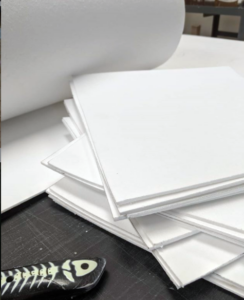
Protecting the kiln shelf can be done with either kiln wash or with fiber
paper. (Using both is not necessary.) If you decide to use fiber paper, first
cut it to fit the shape of the shelf (scissors will work well). Then fire it to
about 1400 degrees F (760C) to burn out the binder that holds the fibers together. The
kiln should be vented during this procedure, as it may smell (like burning
sugar) and may give off a mild dark smoke. Although the smoke from the burning
binder is not harmful, the odor can be unpleasant. For this reason, good
ventilation is essential when pre-firing fiber paper.
Once the fiber paper has been fired, it is ready to use. Most fiber papers
have one side that is relatively smooth and a second side that has a light
texture. You can fire with either side facing the bottom of your glass.
Fiber paper can also be re-used, but to do this you must peel it away very
carefully to avoid ripping. This process works best if the fired item is allowed
to totally cool before removal. Despite your best efforts, some fibers of the
paper will probably stick to the underside of the glass. These loose fibers are
potentially hazardous if inhaled, so the best way to remove them is to place the
glass item under water and lightly rub them off. Wear a respirator if your warm
glass activity requires you to work with loose fibers in the open air.
Unless the fiber paper has become soiled, it should be saved and re-used. In
addition to its use as a shelf protector, fiber paper can be used in several
other ways, the most common of which is to control the flow of glass during a
firing.
In addition to the kind of fiber paper discussed above, which is generally
about 1/4" (3mm) thick, Bullseye also makes a "thinfire" fiber
paper that is designed to protect the shelf for a single firing. This is a
relatively expensive way to get the job done, but it does have the advantage of
expediency and also leaves an attractive sheen to the underside of the fired
item.
Another kind of fiber paper which last longer than most is called 110 fiber
paper. If handled properly, this rigid product lasts from 25 to 75
firings. Click here to learn more
about 110 fiber paper.
Some artists like to kiln wash over the fiber paper in order to create a more
desirable texture on the underside of the glass being fired. There's no harm
in doing this, but either kiln wash or fiber paper alone are sufficient to keep
the glass from sticking to the shelf.
PLACING THE KILN SHELF IN THE KILN
While it doesn't matter whether you place your item to be fired on the kiln
shelf prior to putting the shelf into the kiln or afterwards, you should make
certain that you do not place the shelf directly on the kiln floor. It should be
raised off the floor at least half an inch, so that air can circulate under the
shelf.
The best way to do this is to use kiln posts, short "legs" that are
usually made of the same kind of ceramic material as the shelf. Three posts are
sufficient, although four may be used. Select posts that that are about half an
inch high and place them under the shelf in the kiln. These support posts do not
need to be kiln washed, but there's no harm in doing so if you prefer.
Once the kiln floor and shelf have been protected and the shelf
is supported in place, you are ready to begin your warm glass projects.
Click here to
go to the next part of the tutorial, "Keeping a Firing Log."
|